In this article
Specialty rental has become the fastest-growing corner of the equipment rental business. Temporary cooling, power, pumping, and trench safety jobs tend to be bigger and more involved than a standard rental. One project can mean dozens of units, the accessories that go with them, and a billing setup that looks nothing like a day rate.
That growth is a real opportunity for operators. It also asks a lot more of the software they run their business on.
The largest rental companies are betting on specialty
You can see the trend in the big three's latest earnings.
| Company | Period | Specialty rental revenue | Growth vs. prior year |
|---|---|---|---|
| United Rentals | Q3 2026 (Jul to Sep) | $1.704 billion, a quarterly record | 34.7% |
| Sunbelt Rentals | Fiscal Q1 2027 (May to Jul 2026), North America | $1.070 billion | 25.3% |
| Herc Rentals | Q3 2026 (Jul to Sep) | Not broken out | “Double-digit” |
Each company defines specialty a little differently, and acquisitions play a part. Sunbelt says its Reliant Asset Management deal added about three points of rental revenue growth, and Herc points to its H&E acquisition.
Even so, the direction is clear. The biggest players are leaning into specialty, and it's become one of the main drivers of their growth.
Why specialty rental is harder to run
A general rental is usually one machine, one contract, and a predictable bill. Specialty work behaves more like a project, and that changes what operators need from their software.
Large projects with a lot of moving pieces. Cooling a data center or shoring a long trench can mean large quantities of equipment and accessories going out together, and the order often changes once the job is underway. Teams need to see the whole job in one place and keep up as it changes.
Billing that matches how the customer buys. Specialty customers often buy a complete solution and want an invoice that reads that way. Operators still need to know what each piece of equipment earned. That means splitting project revenue across the underlying assets while the customer gets a bill that makes sense to them.
Knowing where the fleet is and how it's performing. Specialty fleets are spread across job sites, and a lot of that equipment runs around the clock. Telematics only helps if it shows up where dispatch and service work, so teams can see where units are deployed and which ones need attention.
Moab was built for this kind of work. Jobs run as projects, and project revenue is split across the equipment behind it. Telematics feeds into dispatch and service, though what's available depends on the equipment and the provider.
Where AI makes the biggest difference
Specialty projects create a steady stream of customer requests, whether a customer needs more units on site or wants to keep a rental out a few more days. Each of those requests used to mean someone retyping an email into the system.
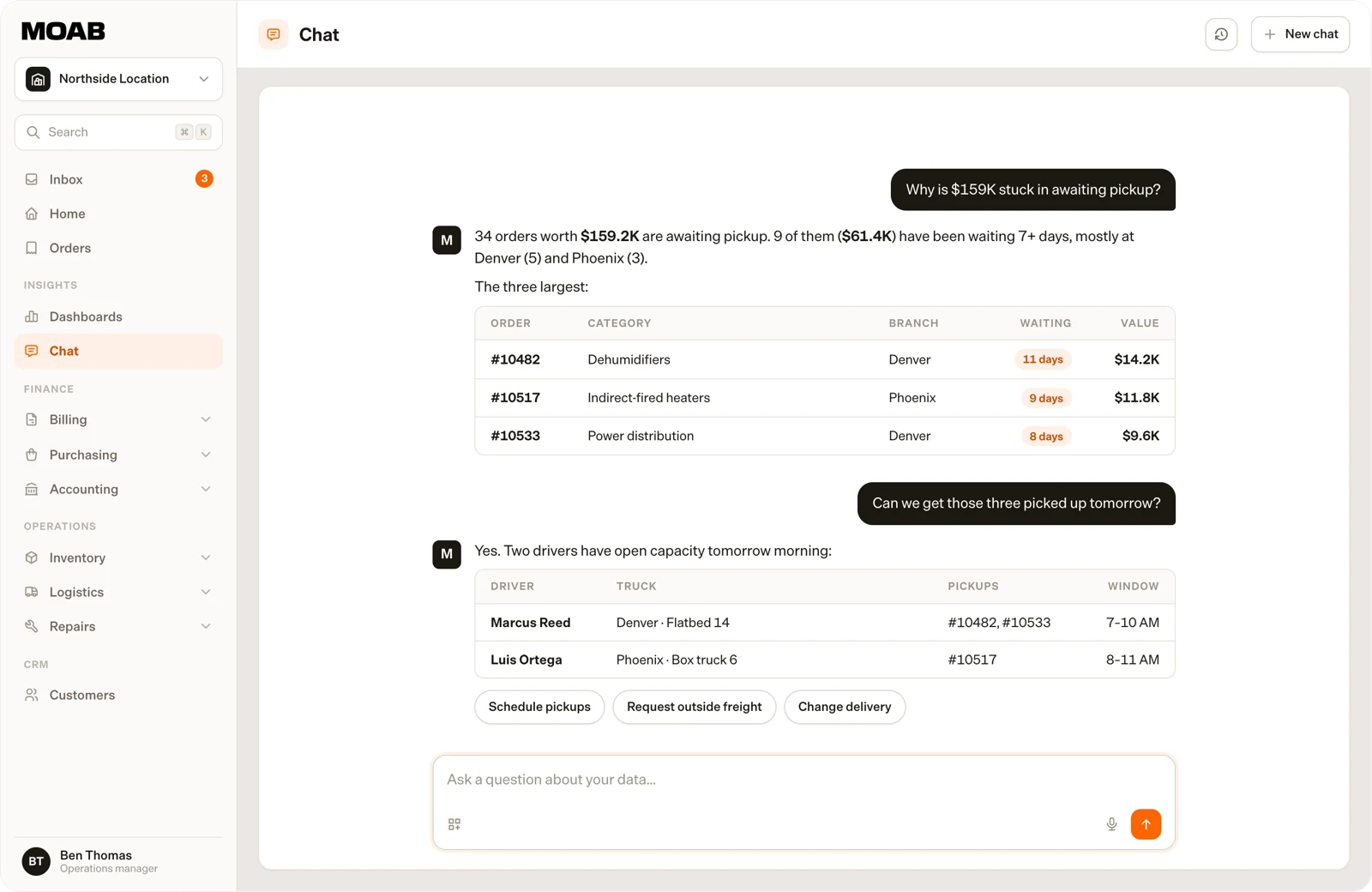
Moab is an AI-native equipment rental ERP, so its AI works inside the same system as dispatch, inventory, and finance. It reads and sorts incoming requests and drafts the work for a rep to confirm. It also applies customer payments to open invoices, which matters when one project produces a lot of invoices.
Axis Portable Air shows what that looks like at scale. 48% of Axis's invoiced revenue came from requests that Moab's intake agent read and classified. From summer 2025 to summer 2026, Axis grew revenue more than 50% while adding 9 new branches. Read the Axis story
What to look for in specialty rental software
If you're evaluating software for a specialty fleet, a few questions will tell you a lot.
Can it run a job as a project?
Ask the vendor to show a live job with dozens of units and accessories on it, then add a few more mid-rental. If that change means editing several contracts by hand, it won't hold up on a data center job. The whole project should update in one place, and dispatch should see the change right away.
Can it bill for a solution and still track each asset?
Specialty customers want an invoice for the package they bought. Your finance team wants to know what each asset earned so it can price jobs and plan fleet purchases. Good software does both from the same data, with no spreadsheet in between.
Does telematics show up where the work happens?
Most specialty fleets already have telematics. The real question is whether location and engine hours show up inside dispatch and service or sit in a separate portal nobody checks. Ask which providers the software works with and what data actually comes through.
Is the AI doing real work?
A lot of rental software has an AI feature now. What matters is whether it handles daily work, like reading a customer email and drafting the order, or sits off to the side as a chat window. Ask how many requests it handles today and how often a rep has to fix what it drafted.
Specialty operators running on Moab
Moab already runs some of the largest specialty fleets in the country. Axis Portable Air rents portable heating, cooling, and power through 50 U.S. branches. National Trench Safety provides trench, excavation, and traffic safety equipment nationwide. TNT Crane & Rigging, No. 13 on the 2026 RER 100, goes live on Moab in 2027, replacing its incumbent software.
The big three's numbers suggest specialty will keep outgrowing the rest of the industry. Axis shows what being ready for it looks like: more than 50% growth in a year, with nearly half its invoiced revenue coming from requests Moab's AI read and sorted. See how Moab runs specialty rental
Sources: United Rentals Q3 2026 results, Herc Holdings Q3 2026 results, Sunbelt Rentals fiscal Q1 2027 results (RER), and the Axis Portable Air case study.